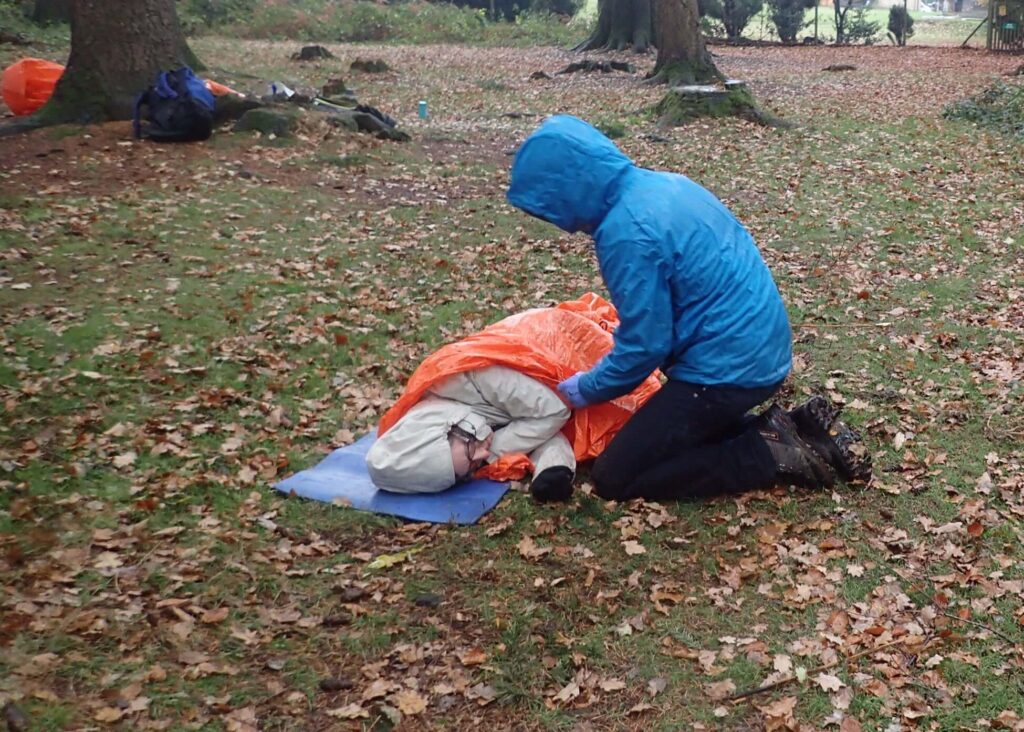
In many first aid incidents, the standard action following treatment tends to be “keep the casualty still, call for help (and have a cup of tea whilst waiting several hours for assistance)”. In an outdoor environment, we have to contend with much more than just our casualty’s injuries or illness. Cold weather, rainfall, delayed emergency services response times. These all make decision making more complex, and in some instances we might consider moving a casualty either by walking them out or moving them a short distance away from a hazard or into shelter. So how do we make that decision as to whether they’re fit to move or be moved? The answer lies in the casualty’s vital signs.
Vital signs are indicators of how healthy or unhealthy our casualty is, and give us both information on their health now and in an ongoing, dynamic situation. They can also give us early warning signs of deterioration in a casualty, which can be really useful in guiding decision-making and knowing when to update the emergency services in a serious incident.
The key vital signs we usually monitor are the level of consciousness, breathing character and rate, and signs of circulation.
Level of consciousness
In first aid world, we have a sliding scale of level of consciousness, which relates to how well our casualty’s brain is functioning. This is known as the AVPU or ACVPU scale.
Alert – this means that our casualty is awake and not confused – they know who they are, where they are and what has been happening
Confused – A casualty can be awake, but not fully alert if they have some signs of confusion
Voice – We’re now into casualties who are not fully awake, but if we should loudly, giving an instruction such as ‘open your eyes’, we might get a groan or flickering eyes. The casualty is responding to the first aider’s voice.
Pain – Casualties who don’t respond to voice are clearly unwell, but may not be as bad as they could be. If we now shake our casualty’s shoulders (assuming no injuries here) and the casualty groans or pulls away, this is referred to as a pain response.
Unresponsive – A casualty who doesn’t even respond to pain is referred to as unresponsive. This is about as unwell as somebody can be, so worth knowing about and calling out for help at this point.
Breathing
Air is going in and out: fantastic! But how do we know that it is, and that it’s going in and out as effectively as it should? Within our Primary Survey, we typically look for breathing movement, feel for air being breathed out and listen for quiet breaths. We may however find something concerning at this stage.
Noisy breathing is often a sign of an obstructed airway, and would be a concern. If a first aider thinks they know the cause of this and can fix it, this is essential at this point. Some of the noises we may hear could include snoring (usually the casualty’s tongue obstructing their airway), wheezing (may be medical or injury), gurgling (fluid blocking the airway) or agonal gasps,which indicate a cardiac arrest.
If the breathing appears normal, a more in-depth assessment now includes considering how deep the breathing is, and how rapid. Counting breaths for 30 seconds and then multiplying the answer by 2 will give us a breathing rate over 1 minute. A normal breathing rate at rest for an adult is 12-20 breaths over 1 minute (6-10 over 30 seconds).
Circulation
Blood is going round and round, and reaching all of the right places: that’s what we’re hoping to see, but how can we tell? There are a few things we can look for in assessing circulation: skin colour, capillary refill and pulse.
Although there are a huge range of possible skin colours we come across, everybody is pink on the inside as long as they’re healthy. A good place to look is just inside the lips or beneath the lower eyelid. In either of these places, you should find pink skin. If we lay a hand on the back of our casualty’s neck, we hope to find that it’s a similar temperature to our own and dry, not clammy.
A capillary refill test (CRT) means squeezing on the skin and timing how long it takes for colour to return to the area. This is often done on a thumbnail, but cold environments can affect this, even if circulation is otherwise working well. A better measure of core circulation is to squeeze on a forehead or the sternum. If we squeeze for 5 seconds, colour should then return within 2 seconds.
A more in-depth assessment would involve taking a pulse, assessing for the rate, the regularity and the strength of the pulse. A normal pulse for an adult at rest would be strong, regular and somewhere between 60-100 beats per minute in most cases, although lower pulse rates are more common with fairly fit and active individuals.
Clues and signs
Imagine the scene: we find a casualty with suspected injuries. They are alert, breathing regularly at a rate of 16 breaths per minute and have a strong regular pulse, with a rate of 72 and pink, warm, dry skin. At the moment this all looks relatively normal, but this is only a snapshot. Knowing that help will be delayed, we check again 10-15 minutes later and now find a breathing rate of 22, pulse rate of 90, slightly paler skin. Another 10-15 minutes later we have a confused, sleepy casualty with a breathing rate of 26, pulse of 104 and pale, clammy skin. What’s going on?
The signs we’re detecting, changing over time, suggest the casualty is developing shock. Even if you don’t know what’s wrong, the signs suggest that something’s changing, which should prompt us to do 2 things – firstly update the emergency services on the changing casualty and secondly start again, reassessing the casualty to make sure that we haven’t missed something at an earlier stage. Without monitoring the signs, we may only detect the changes far later.
Vital signs monitoring
Vital signs are a window into how healthy or unhealthy a casualty is. One set of vital signs can give us an early indicator of if there are any major problems for our casualty, but once we have more than one set, we have the beginnings of a trend, assessing for changes over time. These signs are fairly straightforward to monitor, but difficult to remember in a stressful situation. That’s one of the reasons we recommend having casualty monitoring cards (cas cards) in your first aid kit, as a reminder of what to monitor and a record over time.