The foundation of first aid
There’s an awful lot to remember when you’re a first aider, from medical conditions, signs and symptoms, how to recognise serious injury and much more. That’s why the foundation of any of our first aid courses is a good understanding of the primary survey: a simple system to ensure you find and treat the most important issues first. There are various acronyms out there to help you to remember the primary survey (DRCAcBCDE, DRABC, ABCDE, MARCH and others); all of these follow the same basic system, but with slight differences in how it’s explained. We use DRABC on our courses, with one exception to the system.
Danger
Assessing for dangers in the environment is the single most important task a first aider has to perform. It feels quite natural to want to rush in and help when somebody is unwell or injured, but it’s critical that the first aider takes the time to assess for hazards first. Common hazards that can be overlooked include vehicle movements, slippery ground and sharp objects on the ground, but there are many other possible hazards to a first aider. The most important person at the scene is the first aider, so they need to ensure their own safety, as well as that of any bystanders or other helpers. It seems counter-intuitive, but unfortunately the casualty is last in the priority list; they’re already injured or unwell but we’d like to keep them as the only casualty. Assessing for dangers also includes considering whether the first aider needs any personal protective equipment such as nitrile gloves if there are bodily fluids evident and weighing up what appears to have happened to the casualty (the mechanism of injury) – could it happen to the first aider too. Finally, don’t forget that casualties can also harm first aiders sometimes; unwell and injured people may be frightened and confused, so take care in your approach to assess their response carefully, and be prepared to back away and start again if needs be.
Response
At an early stage, we assess the level of consciousness of our casualty, to gain an initial insight into just how unwell they appear to be. This forms part of an overall vital signs assessment, which we’ll revisit again later on in caring for our casualty.
Airway
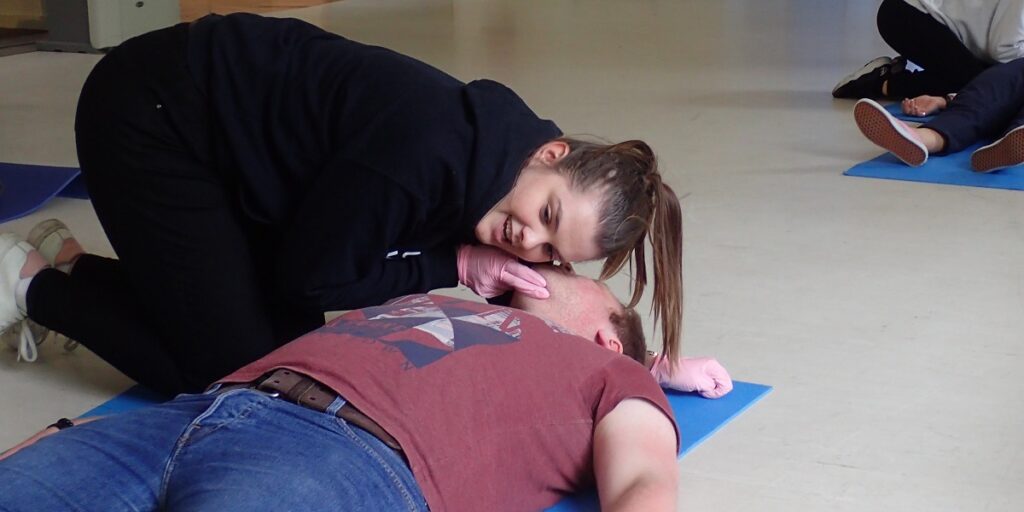
The airway runs from the mouth and nose to the lungs. Airway obstructions can be rapidly fatal, so we assess for any obvious airway issues at an early stage. In an unresponsive casualty we typically manage their airway for them with a head tilt (gently moving the head back) and chin lift (moving the jaw forwards) in order to ensure the airway is as open as we can achieve. This manoeuvre moves the tongue away from the back of the throat, clearing the way for the casualty to breathe. Other airway issues we may detect during a primary survey include choking and asthma. Any airway problems we detect that we can address, we do so before moving on.
Breathing
Our assessment of breathing is concerned firstly with “is the casualty breathing?” In an unresponsive casualty, we look for movement of the chest and abdomen, listen carefully for quiet breaths and feel for exhaled breath for 10 seconds. Alongside the question of whether they are breathing however, we’re also assessing whether the breathing is normal. Normal breathing is smooth, quiet, regular and effortless. Noisy breathing can be a sign of airway obstruction (e.g. gurgling sounds indicating fluid obstruction) or in the case of slow, noisy, irregular gasps in an unresponsive person, this is a cardiac arrest.
In conscious casualties, we’re assessing the quality of their breathing as well, but perhaps in a slightly different manner. Talking to the casualty can provide clues; they may be short of breath, with frequent pauses in conversation, they may be struggling, with their upper chest and shoulders moving noticeably to help them breathe and they may be making noises including wheezing and coughing, which can indicate obstructions and medical issues. If there are any problems detected at ‘B’ that we can deal with, we do so before moving on.
Circulation
There are several things that can be assessed as part of circulation, including skin colour (should be pink around the lips and inside lower eyelid), temperature (warm, dry skin), pulse and capillary refill. All of these are covered in our vital signs blog and, although they’re important signs to check, they may only indicate to you that something is wrong, without knowing what that is.
One circulation issue we may detect and be able to treat immediately however is external bleeding. The thoroughness of a check for blood loss will be influenced by the nature of the incident, what the casualty is able to tell you and how they are dressed among other issues. At this stage however, we should always be considering the possibility of bleeding and checking for signs. Any issues we detect at ‘C’ that we can deal with (you’ve probably guessed by now), we treat before moving on in our casualty assessment.
But what about really big bleeds?
This is the exception mentioned at the beginning of this blog. If you’re unlucky enough to be faced with a catastrophic haemorrhage , or immediately life-threatening bleed, this takes priority above the airway. Controlling the bleed is the most important action you can now take, other than assessing and managing dangers; if your casualty has a life-threatening bleed, there’s almost certainly a danger to you somewhere!
On our first aid courses, we teach DRABC as the primary survey system, but with the one exception of life threatening bleeds. We believe that having a simple, easy to remember system supports first aiders to feel confident and act competently.